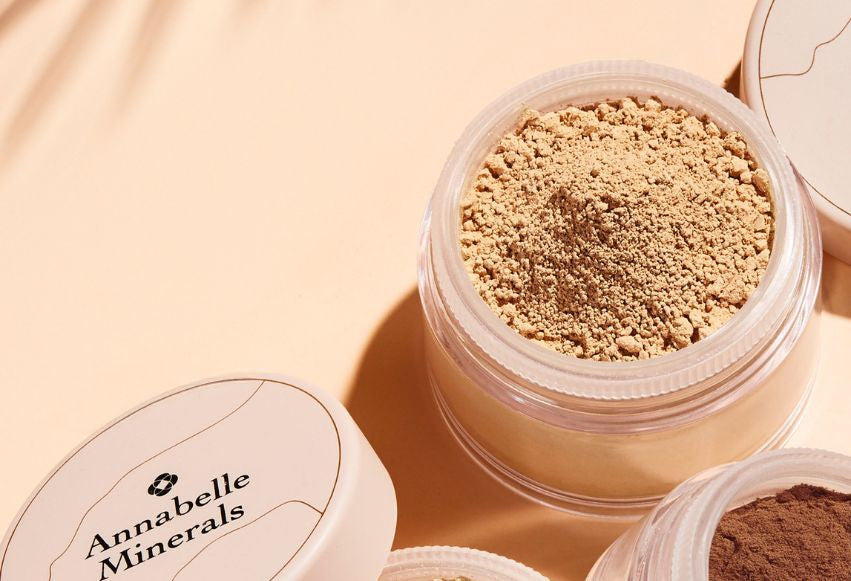
Mineral cosmetics, like any other cosmetic product, despite their multifunctionality, do not meet the needs of absolutely all skin types. They are not universal products designed for everyone, so a certain group of people will be dissatisfied with their performance, finish, and properties, as minerals may look unattractive, have poor longevity, exacerbate skin problems, or even cause them.
The requirement to maintain high hygiene, great emphasis on care and the correct selection of mineral makeup application techniques
Mineral cosmetics are products with a unique specificity. Their loose formulas require essential accessories, such as brushes and sponges, which in turn require regular washing and thorough disinfection with broad-spectrum products (e.g., Skinsept). Hygiene is crucial in this case, as many people blame mineral cosmetics for causing acne, and the cause may be poor hygiene of the accessories used or excessively sharp, unpleasant bristles, which can mechanically irritate delicate skin.

Minerals don't contain any additives, so to look natural and be long-lasting, they require careful skincare. They can balance the skin, enhancing the beneficial effects of skincare routines, but they won't save the skin on their own and won't replace essential cleansing, moisturizing, nourishing, and exfoliating products. After all, they're a simple mineral powder. Any lack of moisture or heavily blemished skin will highlight the problem, and while there are tricks to camouflage the problem, on their own, minerals won't last long or provide satisfactory coverage or a natural, healthy result.
Choosing the right application method also plays a significant role in your satisfaction with mineral products. Loose cosmetics require more attention and caution, as well as some practice. However, don't be discouraged. You'll get the hang of it after just a few tries.
Minerals can cause skin dryness
They are based solely on loose, semi-finished products. They do not contain any additional, occlusive substances, which in cream foundations are responsible for the fluid, enveloping, and tightly adherent texture. Mineral cosmetics can therefore exacerbate dehydration and dry out skin, which tends to lose excessive water and requires constant protection in the form of emollients. Unfortunately, on this type of skin, powders will accentuate the flaky, uneven texture, cause burning, itching, redness, and folliculitis. They will also not be long-lasting, and the final effect will leave much to be desired – powders will provide a very powdery and uneven finish. Instead of gradually improving the skin's condition, mineral cosmetics will unfortunately progressively worsen it. If the skin is not prone to severe dehydration, using mineral foundations in combination with a moisturizer or oil may be the solution. The foundation will acquire a creamy consistency and maintain proper skin hydration.

In some cases, they may increase seborrhea instead of normalizing it.
The drying effect of minerals can cause induced seborrhea, which can cause the skin beneath the minerals to sweat excessively and become oily, thus contaminating the skin. Mineral foundations also have completely different ingredient ratios, although the concentration and ratio of titanium dioxide to zinc are most important. Formulas can have different consistencies and behave differently on the skin. Heavy, high-coverage powders, like traditional makeup, although they lack a full arsenal of excipients, can create an excessively heavy, mineral (and actually oily) layer when in contact with sebum, weighing down the skin, exacerbating seborrhea, promoting acne development, and significantly worsening the complexion. In such cases, it's worth choosing less pigmented minerals (those containing more zinc oxide and less titanium dioxide, or none at all) and limiting the application to a thin, powdery layer. Sometimes, however, the skin does not completely match this consistency and you should give up on mineral makeup.
May cause allergic-like reactions
Although minerals are among the safest cosmetic formulas, they can also cause unforeseen negative reactions. Most allergies are caused by iron oxide pigments used in mineral cosmetics, although a group of people are hypersensitive to titanium dioxide. A negative reaction usually manifests within a few hours, although it can last up to several days after regular use of mineral foundations. In such cases, a typical allergic reaction (itching, burning, swelling, local blistering) or acne-like reactions develop, typically resulting in inflammatory lesions. People hypersensitive to titanium dioxide most often exhibit a similar reaction to cosmetic talc and most mattifying powders containing highly moisture-absorbing ingredients, such as silica and cellulose.

They can indirectly cause acne
Because when used incorrectly and on the wrong skin type, they can disrupt the skin's balance and promote irritation, inflammatory reactions, and increased seborrhea. Minerals represent a beautiful, healthy minimalism, but it's not suitable for every skin type. Every skin type has different requirements, and not everyone can embrace powder extremism.
They are not suitable for very seborrheic skin.
In such cases, any makeup exacerbates skin problems because it acts as an additional occlusive agent. Minerals don't possess strong enough absorbent properties to act as a sponge for the massive amounts of sebum produced, so they can—like other foundations—intensify this problem and complicate further skincare and treatment procedures. On skin with a high seborrheic dermatitis, minerals will always separate, accentuating pores, creases, and unevenness, and have significantly poorer longevity. To enjoy long-lasting mineral makeup, you should first treat the causes of seborrhea and only then attempt to reach a consensus with mineral powders.
They do not contain any additional substances, so they may prove to be less durable and have poor adhesion.
Mineral cosmetics are based on just four ingredients. They lack an emollient base, ingredients that improve the product's adhesion, consistency, and usability. On more demanding skin types, they may prove to be less long-lasting, fade quickly, and provide poor coverage.

They are not waterproof
Without proper setting and application technique, mineral cosmetics are not waterproof, so they will always be more susceptible to abrasion, sweat, and sebum. Although they have gentle degreasing properties, they are not powerful enough to ensure long-lasting, flawless results for many long, active hours. Don't expect miracles. Of course, in other cases. are much more durable than conventional dyes, and sometimes even outperform them.
Mineral cosmetics are exceptionally gentle products, providing high coverage, hypoallergenic, and lightweight. However, you need to learn how to work with them. Every skin is different, so there's no single recipe for using mineral foundations. You need to find a way to use them and not get discouraged after initial unsuccessful attempts. Remember, however, that not everything will work for everyone. Therefore, even with mineral makeup, there will be cases where foundations may not live up to expectations. In such cases, you should examine your skin and its care regimen, diagnose any problems or allergies, and understand its needs – ideally in consultation with a specialist.
Ewa Szałkowska – young, ambitious, and creative. Passionate about art, she loves good food, and dark chocolate. For several years, she has been passionate about mineral makeup and is learning it from the ground up. With immense passion, she runs a unique online space where she shares her knowledge and experience in skincare for problematic skin in an accessible and creative way. Founder and author of the blog http://www.ewaszalkowska.com/
