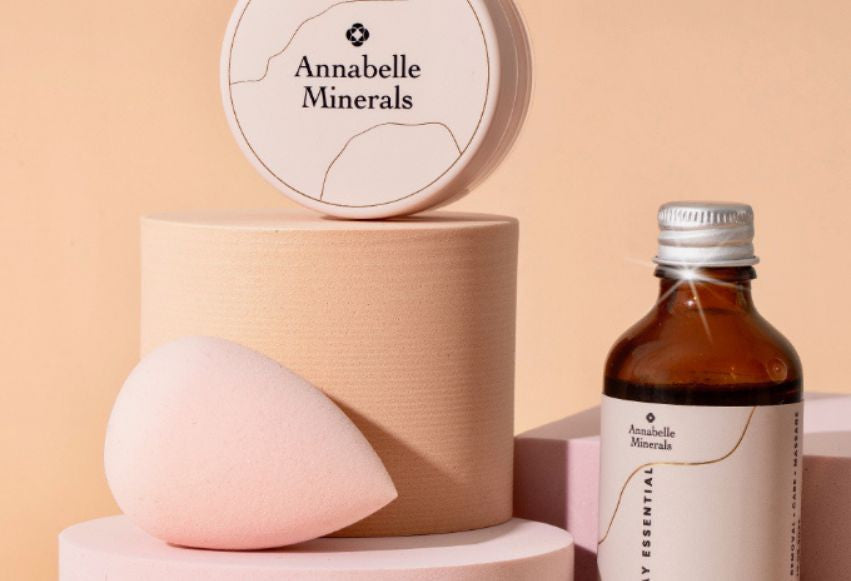
In the first part, you learned how to apply Annabelle Minerals products using accessories and various techniques, while maintaining the foundation's loose consistency and not altering its mineral composition. Today, I'm taking a completely different approach, as loose products can easily be transformed into liquid foundations. This form significantly simplifies application and also provides adequate hydration and a protective layer throughout the day. This is especially important during windy autumn and winter.
The main advantage of mineral foundations is their short composition. However, some skin types, despite proper epidermal preparation, will struggle with even distribution of the product in its loose form and with its longevity. However, the main issue will be the final appearance – especially when the foundation is applied to dry, rapidly dehydrated, and calloused skin.
Mineral foundations can be easily mixed with creamy and oily textures. This allows the mineral product to lose its loose consistency and become more creamy. A major advantage of this application method is that you know exactly what your foundation base is – it could be your favorite moisturizer, sunscreen, or even an oil or butter that works well in your daily skincare routine. Traditional makeup always poses a certain risk to your skin's condition due to the multitude of ingredients and varying compositions, especially if your skin quickly becomes polluted and reacts negatively to most liquid foundations. Mixing mineral foundations with oily and creamy textures becomes a perfect compromise. You can easily use loose mineral foundation and a proven liquid base for this purpose. An additional advantage of homemade liquid foundation is the ability to build coverage and directly influence its finish and longevity.

Liquid foundation with a moisturizing cream base
This combination creates a very natural, slightly even-toned finish. It's certainly not suitable for those who require heavier coverage. This method doesn't emphasize dry patches, provides adequate hydration, and prevents foundation from settling and settling unsightly onto imperfections. Surprisingly, more moisturizing formulas tend to highlight dry imperfections more.
The final effect, of course, depends on the cream used. A consistency that's too oily can unfortunately highlight imperfections and significantly shorten the wear time, while a consistency that's too dry can tighten the skin. Annabelle Minerals Soft Cream is ideal for mixing with mineral foundation, thanks to its very light, non-greasy consistency. Keep in mind that adding mineral foundation to a cream provides a better mattifying effect, and the cream will behave differently on the skin. In most cases, the cream will set. However, I would avoid gel-cream formulas, which set and are dry to the touch.
Also, be careful not to add too much foundation to the cream. You may have It can be difficult to distribute evenly. Cream-based tinted foundations should be thoroughly massaged into the skin, carefully mixing the mineral powder with the creamy foundation to avoid any lumps. My advice: if the foundation feels too thick to the touch, add a few drops of silicone-raspberry complex.
This method is ideal for people who have problems with dehydrated skin, and mineral foundations applied directly to the skin make dryness more visible or give an overly powdery effect.

Liquid foundation with a cream base that provides sun protection
Adding mineral foundation to sunscreen works equally well, but the combination creates a wetter, more moisturizing effect. Sunscreens typically have a rich base that blends perfectly with the mineral pigments. Importantly, – A small addition of mineral foundation doesn't destabilize sunscreens (with more foundation, the UV protection is significantly reduced), but actually increases their stability. The foundation provides a natural, very subtle effect, slightly evening out skin tone, and also counteracts the greasiness of sunscreens. For this purpose, it's best to use only chemical sunscreens, as the pigments dissolve best in them, and their base is generally more runny and susceptible to modification. This is a very good solution for those who use stable sun protection but also need to slightly even out their skin tone.
Remember a simple rule: the less mineral foundation you add to a creamy consistency, the more natural the foundation will look and provide a more luminous effect. The more you add, the more matte and opaque it will be. Therefore, you can add more mineral pigments to creams rich in oils or very fatty ones.

Oil-based liquid foundation plant
Add a few drops of oil to loose foundation to create a uniform, not too thick, non-runny consistency (about one part of oil per five portions of foundation). Surprisingly, vegetable oil foundation isn't overly greasy, providing only a very delicate, wet finish. This foundation provides very high coverage and is waterproof, but unfortunately, it can have one drawback: it can accentuate dry patches and skin texture. It also settles in the hair, which is clearly visible in photos. Why does this happen?
Unfortunately, these are just two ingredients; foundation loses these properties when you add cream to the oil, for example, up to half the volume of the created foundation. The oil itself, along with the pigments, penetrates the skin's texture and will unfavorably emphasize both convexities and concavities. However, adding cream, which contains additional ingredients, will prevent such an unsightly appearance and properties of the created foundation.
Vegetable oil foundation has very strong pigmentation, is also extremely long-lasting, and has a completely non-greasy finish. Its consistency and properties are similar to those of highly durable, waterproof liquid foundations based on silicones. It glides on very easily, with gentle movements. For this purpose, it's best to use vegetable oils with very good glide, such as chia seed oil, strawberry oil, raspberry oil, blackcurrant oil, tea seed oil, and possibly hemp oil. You can also choose ready-made blends, such as Stay Calm oil from Annabelle Minerals . However, non-drying oils, such as coconut oil, macadamia nut oil, or sweet almond oil, won't work, as they will cause the foundation to curdle. emphasized imperfections.
Applying oil-based foundation is incredibly easy, but it's crucial to apply the product very carefully (preferably with your fingers or a brush with lots of bristles) and not overapply. The final result depends primarily on the condition of your skin – if you have typical oily, combination skin, free of imperfections and not prone to dehydration, the oil method will produce a very natural, yet opaque effect.
Covering camouflage based on natural vegetable butter
You can create full-coverage camouflage in the same way. Simply add about 8-10 times more foundation or concealer to a thick, opaque oil (shea butter, coconut oil, cocoa butter, or even avocado and pracaxi oil), creating a very thick, full-coverage camouflage. The concealer has very high coverage and can even cover tattoos if the mineral powder is thoroughly dispersed in the oil.
Mineral foundations can be used not only in traditional loose form, but also in liquid form if you're not convinced by powders. In addition to the methods mentioned above, you can also enhance your liquid foundation with loose mineral foundation if, for example, it lacks coverage.
Ewa Szałkowska – young , ambitious, and creative. Passionate about art, a lover of good food and dark chocolate, she has been passionate about mineral makeup for several years and is learning it from the ground up. With immense passion, she runs a unique online space where she shares her knowledge and experience in skincare for problematic skin in an accessible and creative way. Founder and author of the blog www.ewaszalkowska.com
