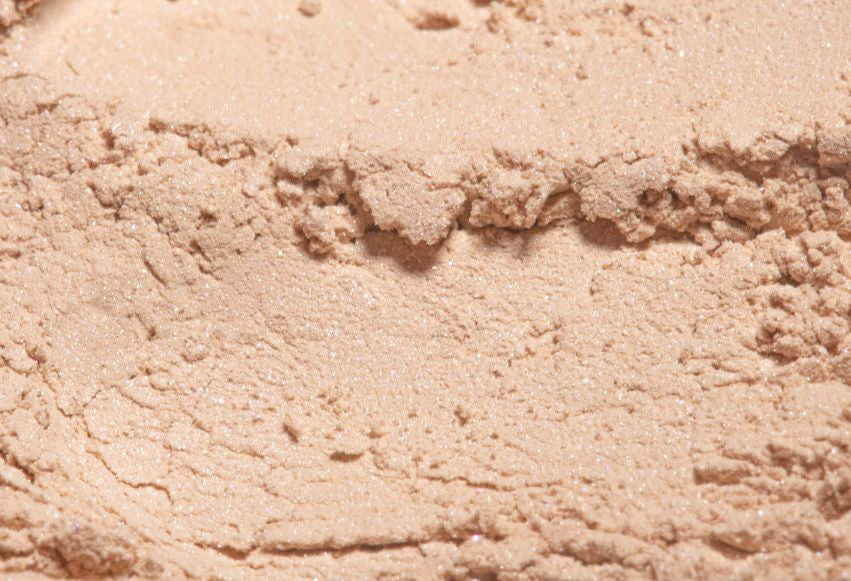
Mica serves as a core component in Annabelle Minerals mineral cosmetics, the most common (with a few exceptions) main ingredient in foundations, eyeshadows, blushes, concealers, and even powders! What is it, what are its properties, and why is it so popular in our products as a filler? What is worth knowing about it?
Mica
It is a natural mineral—sericite—that belongs to a broad group of silicates. Mica does not cause irritation or toxic reactions; however, extremely rare cases of hypersensitivity to mica may occur due to improper purification during production.
What is characteristic of micas is their diversity – it is an extremely rich family with significantly different properties, although the most important factor in this case is the method of obtaining cosmetic mica and the degree of its fragmentation.
Most micas have delicate, shimmering particles and a subtly satin, elegant finish, which is why mineral cosmetics, despite their loose form, add an unobtrusive glow to the skin and ultimately look incredibly natural and fresh.
Due to the origin of the raw material, the method of its extraction and processing, there is a significant discrepancy in the sensations experienced when using mineral cosmetics - depending on the type of mica used (and not only that), the cosmetics may have a completely different consistency and react extremely when in contact with sebum or sweat.
Contrary to appearances, even seemingly matte micas (due to their extremely fine texture) do not possess high absorption properties, are neutral to the skin, and despite their loose form, do not dry out the skin. The use of sericite in mineral foundations guarantees uniformity, delicacy, fluffiness, velvety texture, a satin, soft finish, and a silky powder consistency.
Functions of mica in mineral cosmetics
Thanks to mica's characteristic delicate and fluffy structure, sericite has found its way into makeup and skincare products (especially in illuminating and anti-aging lines). Products containing mica spread noticeably better, have a unique, smooth finish that visually smoothes the skin and pores, reduces the appearance of wrinkles and imperfections. Despite its dry mineral powder form, the foundation is gentle on the skin, doesn't dry it out, and works perfectly even on imperfect complexions for hours. Mica's radiance closely resembles the skin's natural glow, so the term "illuminating" is often mistaken for "shiny."
Mica is a neutral base – it doesn't cause allergies, is light, and gentle. Thanks to mica's relatively weak adhesion, which can be improved by modifying its surface, the mineral pigments spread evenly across the skin – they don't smudge or create streaks, and the cosmetic itself has a pleasantly fine consistency.
Sericite doesn't exacerbate skin dryness or stimulate excessive seborrhea. However, foundations based on illuminating micas can, over time, create a rather wet finish, which isn't for everyone, especially those who prefer a strong matte finish. It's worth keeping this in mind when choosing a mineral foundation formula.
Mica does not age or deteriorate; it is a stable and safe raw material. It is non-comedogenic and can be safely used even by people with extremely delicate, sensitive, and damaged skin after aesthetic medicine procedures.
Ewa Szałkowska – young, ambitious, and creative. Passionate about art, a lover of good food and dark chocolate, she has been passionate about mineral makeup for several years, learning it from the ground up. With immense passion, she runs a unique online space where she shares her knowledge and experience in skincare for problematic skin in an accessible and creative way. She is the founder and author of the blog www.ewaszalkowska.com .
